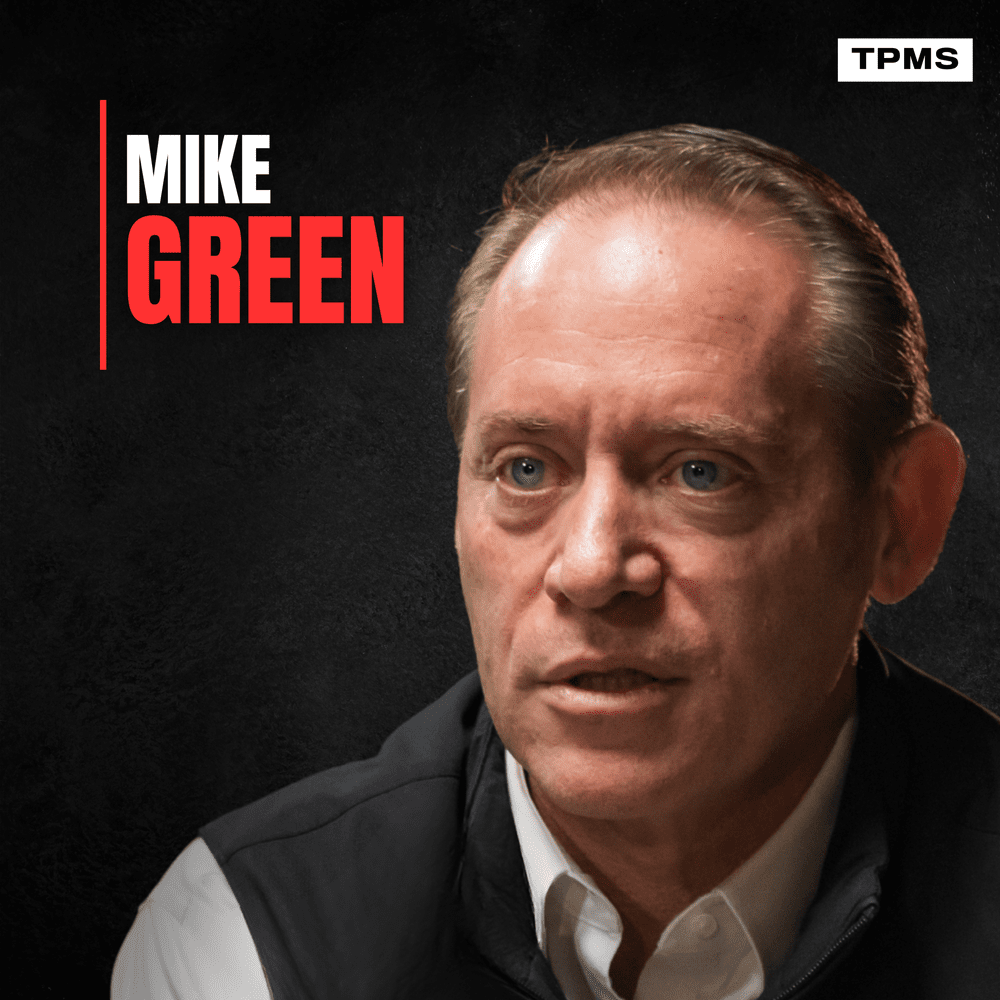
#162 - Mike Green: The Great Financial Reset Has Already Started

Mike Green on The Peter McCormack Show
 

Listen: SpotifyApple PodcastsFountain
Watch: YouTubeRumble

Are we heading for a mathematical market crash, or has the system just been perfectly designed to extract your wealth? Macro-strategist Mike Green returns explains the hidden plumbing of the global economy - why the stock market is no longer tied to reality, how passive index funds have created a "flow inelastic trap" and why the retirement system is forcing a generational wealth crisis. We also explore the brutal economic realities of the Middle East conflict, how monopolies have captured free-market capitalism and how corporations are using AI to eliminate jobs for the younger generation.

Related episodes:


  • Peter McCormack

    Hi Mike, the powers that be have decided that we need another war, and this is coming after what appears to be two or three decades now of crisis after crisis. I think people are a bit worn out by it. But what is the economic reality of this war? Because I'm thinking in terms of the normal guy going to work, who seems to be the one who pays for every one of these

    Mike Green

    Well, I mean, I think that there's a couple of separate components that play in here. First, in terms of the impact, obviously, this is going to be painful for the average person who drives to work, et cetera, gasoline prices are going up, as you know from our prior conversations and from lived experience, most households don't have a lot of spare savings laying around the statistic in the United States, despite the official stats that nobody's poor in the United States, or that, you know, 59% of households can't afford an unexpected $1,000 cost. This is that unexpected $1,000 cost the average household has, you know, one and a half cars in the United States drives about 20,000 miles a year. Average car gets about 25 miles per gallon. And so if there's $1.50 increase in gasoline prices, and it sustains for any period of time that's give or take, $1,000 expense that they did not budget for, and this is going to put pressure on them. The same is true in the UK. You have better public transportation systems, but you still rely on gasoline, et cetera, for many of the things that you look at, and that's before we consider some of the shortages that people have identified that could hit everything from consumer electronics to industrial production to, you know, the groceries that are in your store that are coming through with a slowed transportation system. So this is going to be an increase in costs in an environment in which many households can't really afford it. At the same time, I would emphasize that one of the things that people are suddenly waking up and recognizing this is that Iran has largely controlled the Straits of Hormuz for an extended period of time, and that was broadly tolerated as long as you know, we appeased Iran and effectively a theocracy within Iran and allowed them to fund all sorts of bad behavior, regardless of what your opinion of Israel and Israel's policies are. The simple reality is that entities like Hezbollah and the Houthis, etc, have been funded by Iran and have conducted any number of terrorist activities around the globe. This is one way of effectively saying enough is enough. Eventually you have to get to regime change. Eventually you can no longer have an economic choke point like the Straits of Hormuz, controlled by an actor that is not dissimilar to Kim Jong Il in Jong Un, I'm sorry, in North Korea, an economic bad actor who effectively can extort a continued regime support through the control of these types of economic choke points north korea largely exists to threaten Japan and South Korea and extort support for their regime on the basis of that Iran is really no different. And so, you know, it's a question that we have to ask ourselves, is this time for change? Is it time for a reassertion of, quote, unquote, a war? Economic Order tied to principles and laws, or is this something that we're willing to ignore for an extended period of time? The United States basically went into the peace talks and said, We need you to give up your nuclear material. And Iran chose to approach it dishonestly, saying, What nuclear material? We have no idea what you're talking about. That's why the peace talks broke down, and why the attacks were conducted, because we recognize that Iran was not approaching this from a honest negotiation standpoint. Everything else that comes out of this is a question of, do we actually want to enforce a rules based order, and are we willing to tolerate the breaking of those rules in order to get there? And so this is, you know, this is a complex topic that I think a lot of people have very strong opinions on, but a lot of it is based on emotional content or the immediate hit to our wallet, which is considerable, and I can't ignore that.

    Peter McCormack

    Yeah, there is an alternative view that the Iranians did enter into these negotiations, and it was the Americans didn't want to. And I think we could go back and forth on that, but I'm not really a geopolitics expert. I care more about the impact on people. But are you is the wider thing you're saying here is that we're in a period of restructuring the global financial system.

    Mike Green

    I think the restructuring of the global financial system has been put on hold, but I do think that is ultimately part of it, right? So, you know, you and many other people have correctly identified that the system as it exists today is not working for many individuals. The diagnosis many make is that's tied to the US dollar, I'm I'm less convinced that's actually the case. I think that much more important component is actually the access to legal remedies, etc, that has largely disappeared. If you look at the UK you know, the single biggest complaint that you have correctly, is that you no longer feel represented by your elected representatives. You no longer feel you have access to a legal system that looks upon individuals as entities with rights that are inherent to them, inherent to them. Instead, it's basically becoming a system of discipline, and understandably, you chafe under that. That makes a ton of sense to me. I think it's, I think it's a mistake to say it's simply tied to the money feature, instead, it's much more tied to the systems of power and control. And increasingly, the average UK citizen and US citizen feels that their elected representatives don't really speak for them. They are captured by other entities, and their access to remedies is quite limited, and these are the conditions that tend to lead to revolutionary or at least populist behavior.

    Peter McCormack

    Okay, when you look at what's happened since the run war started, we've seen the price of oil go up to, I think record was $116 a barrel. There's been a the infrastructure behind the LNG, especially in Qatar. Has been damaged. Are the markets reacting how you expected? Or is something weird going on here?

    Mike Green

    They are behaving largely as I expected? So, you know, we should first separate US markets from global markets. A narrative took place post tariff tantrum in February 2025 that you know, the opportunity set was basically just get away from the United States, right? Let's put money elsewhere. Um, those foreign markets that experienced inflows from US capital and candidly, from the rest of the world, as they tried to get away from the United States, are now having second thoughts, and so we've seen a much more dramatic sell off in European or Asian markets than we have in the United States. As you know, a lot of my work is around the passive bid, the implications of what happens as markets transition from discretionary management to index based management, and until we see a material change in those flows, like I would be surprised to see the s, p, sell off in a significant manner, simply because there's just not that much discretionary capital being put to work here, because that money is coming home from the rest of the world. It tried a brief sojourn, adventure off into Africa and Japan and the rest of the world. As that money comes back, it's causing your markets to sell off us, markets to look relatively good, and people are scratching their head. It's in the same way that they have every year for the past 10 years. Saying this doesn't make a lot of sense, but it does if you treat it as a mechanical system, where, as long as people have jobs, they're putting money into their retirement systems. Those retirement systems are buying equities, and in turn, the prices are being supported.

    Peter McCormack

    So it's the market evolved, then into the way it operates to handle such shocks.

    Mike Green

    Well, the market is continuously evolving, right? It's a complex adaptive system that is influenced by the participants and their behavior. Dollars. And the point that I'm emphasizing is more and more of those participants, whether they recognize it or not, are really just part of a mechanical system. The decision to invest passively, to invest in an S and P index or a total market index is really not an investment choice. It's simply an allocation choice. And you're saying, I will take a portion of my earnings and a portion of a contribution from my employer and put it towards buying these equities at what price, whatever price the market has at, what valuation, whatever valuation is there, I'm going to continue to do it, because that's what I've been told to do. That's what the system is built to do, and it's following through on that process.

    Peter McCormack

    But is that like? Is that a survival mechanism for the system?

    Mike Green

    Then? Well, what it really is a misunderstanding of what retirement is supposed to be. So the way we've built our retirement systems, the traditional pension system was designed to provide income to allow you to no longer work once you've reached a certain age or you'd been injured, you received a pension that paid your cost of living and was potentially adjusted to the inflationary impact of that. That's an obligation of somebody else in the United States. It belonged to a private employer, right? It was a defined benefit, which means it's a liability of that employer. In the late 1960s and early 1970s those systems, the assumptions behind them, began to break. And we were unable to do that, and we shifted our retirement system to basically, hey, the right way for you to invest or to prepare for retirement is to build up a giant stock of assets, a big pile of assets that you hope is not going to run out eventually. That is really what we're reacting to. We've replaced the need for income with a monetary and fiscal incentive, tax incentive to hoard assets, effectively hodling for the boomers. That is really what we're actually seeing. If your mechanism for retirement is of uncertain duration, I don't know what my individual life expectancy is. I don't know what's going to befall me. So I have to assume, effectively, the worst case scenario, that I'm going to live a really long time and that my expenses are going to be higher than I think, etc. And so I'm going to have to accumulate a lot of assets in order to meet that objective, and I'm going to underspend relative to that pool of assets. Everyone else will think I'm rich, but I look at it and say, I don't know how long I'm going to be retired. I don't know how long I'm going to need these assets. I don't know what the value of these assets, because they're relatively volatile assets, is going to be in my retirement. So the answer is, I underspend and I accumulate more and more assets, if at all possible. That has implications for the younger generation. This is effectively a Keynesian paradox of thrift. If the older generation has all the assets and they choose to underspend because they are uncertain about their future. What they really wanted was a guaranteed income, but now they have a giant pool of assets that they have to make last. That means they're going to underspend. They're going to be less that means there's going to be less income for the working generations, which makes it harder and harder for them to buy access into that pool of assets, which includes things like houses, it includes things like safe retirements. It includes things like automobiles, etc, that everybody is basically saying, hey, I need as many of those as I can possibly get, because I'm uncertain as to what they're going to generate in terms of yield.

    Unknown Speaker

    Doesn't feel sustainable.

    Mike Green

    I don't think it is, because it has it falls into a category of what's called overlapping generations models, where we have a very large retirement class. We have people who are living far longer than they would have anticipated. The the proportion of those people that live to adulthood in the boot in the baby boomer generation was far higher than in prior generations. And as a result, we have an economic or a demographic disconnect where we've been we're going to have a growing class of retirees that require those very workers that we're underpaying because we under consume. So it is not sustainable. It will eventually lead to a change, my hunch is that change will be largely again, demographic and feature I've highlighted in one of my pieces, that the modal meaning the most common Boomer age is this year will be 70. Life expectancy in the United States, in the UK, is roughly 85 to 86 across male and female. That means that over the next 15 years, half of those political individuals who vote, demand services, etc, are going to disappear, and they will be disempowered in favor of a younger generation that's going to look at and say, yeah, we've had enough of these old people. That's my hunch.

    Peter McCormack

    So do you think there will be some form of mandani style redistribution?

    Mike Green

    Nation? Well, I think there already is, right, that's what mandami is he's pitching to that younger generation. He is the face of the millennial voter. Whether it's economically rational or not, is somewhat beside the point. That is the will of the people of New York City.

    Unknown Speaker

    It's rational to them.

    Mike Green

    Well, what they you know, this is part of what I wrote about this weekend, right? There's two ways to think about it, is it rational relative to what you believe is actually happening? And for many young people, they see a system that is, in their view, inherently corrupt. And I can understand that I don't necessarily agree with it, but I can understand that perception based on what has happened in their lives.

    Peter McCormack

    You describe in one of your articles, you talked about flow inelastic, unwind. You've talked about this. Can you explain what that is? So someone like I can understand, sure.

    Mike Green

    So flow inelastic refers to the price change that occurs in response to a flow of investment capital. So when I go to buy a share of the s and p5, 100, the measure of elasticity is going to be effectively, how much is the price of the S and P, or the securities within the S and P impacted by that decision to buy or to sell. And what we know and we can see in the empirical data is that inelasticity is rising, meaning we're seeing larger and larger price changes for a change in the dollar amount of flows. Unfortunately, that creates conditions for exceptional volatility, which going back to the original point, if I accumulate a pool of assets and plan to spend that over the course of my retirement. As that volatility rises, I become more excuse me, I become more uncertain, and as a result, reduce my expenditures. And you know when you talk about that implication, that means that reduced spending then translates to reduced job opportunities, which then means that there is less money that will be flowing into the market, creating similar conditions where that even reduced selling activity can cause markets to turn down. It's a little bit like a switch, right? If it turns positive, then prices will tend to rise. If it turns negative, then prices will tend to fall. And one of the key questions is, once it turns negative, does it accelerate? And that's the part that most of my work is focused on, which is there is a bit of a switching behavior as that potentially turns negative, as boomers could see lower prices of equities but still need to sell. Would that overwhelm the inflows and create conditions of what's called a discontinuous price movement or a crash? And unfortunately, most of my work lends itself to assuming that's the

    Peter McCormack

    outcome you're seeing, that what in the short term, medium term?

    Mike Green

    Well, the math behind it suggests that there's a couple of tipping points. We're currently about 54% passive by market capitalization. Our conservative modeling is if we cross about 65% which, on our math, is about two years out, we hit effectively, a point of no return, and at that point it simply becomes a question of when it's going to happen, not if it's going to happen. And so that'll be an unwinding of everything. Unfortunately, that's the direction that it leads to, yeah, kind of necessary, though. I don't think so. I don't think it's necessary. I actually think, look, I think the valuation that many securities trade at is simply too high. I think there are other securities, candidly, that are priced too low. Meaning, for example, I point to many areas of fixed income where there's neglect that's created by these same mechanics. That suggests to me that interest rates are too high, which I know is very contrary to what much of your audience probably believes. We could I could share some of the analysis behind that and why I think that's the case, but the simple reality is, those are the areas the safe investments are the ones that people are being driven away from because of the narrative dominance of it's all about the dollar, etc, right? Why would I want to get fixed income that's going to pay me dollars in the future? If I know the answer is, we're going to massively depreciate the value of the dollar. I just, I don't think that's correct, but that's my opinion about the future, not, not a you know, set in stone guarantee that this is going to happen.

    Peter McCormack

    It feels like a system that's grossly unfair to just like the normal average worker, in that those who understand the plumbing and the mechanics are able to benefit from the system, but those that pay for it are. Are the people who go to work trying to fill up their car, trying to pay their mortgage, who don't understand the plumbing and how the mechanics work and how to play it themselves well.

    Mike Green

    So that is one of the key criteria for money itself, right? You shouldn't have to spend a lot of time trying to figure out the plumbing, right? You don't spend an awful lot of time. And you walk into your house saying, you know, gosh, do I have copper or do I have cast iron pipes right? Have I properly navigated them? Are all turns executed in the most optimal way. You don't spend a lot of time thinking about it, because it's just supposed to work. And again, it, by and large, works right? When you walk into a coffee shop and you pay for something that payment system works. What's not working is the income system and your ability to earn enough to allow you to participate in society, given the costs that currently exist. More and more Americans and UK citizens are experiencing the simple reality, the things that they took for granted as part of their life, right? Being able to afford a nice cup of coffee or tea, being able to pick up a, you know, a delicious meal at a restaurant, those are becoming more and more out of reach for the average worker, and that's creating understandable stress, and it's not being helped candidly by, you know, tech bro leaders saying, you know, all jobs are going to disappear, except for skilled trades. And that's an incredible diminution for many individuals who are raised to look down upon trades as quote, unquote unskilled relative to the niceties of being able to go into an office and put on a tie and, you know, participate in polite conversation around a water cooler. You know, there's going to be some disappointed people if that ends up being the outcome, particularly those in the United States that have spent an enormous and inordinate amount of money on obtaining the credentials that are required to participate in that white collar society.

    Peter McCormack

    What do we do about this then, Mike, I know we touched on this last time I spoke to you, but it does seem like a grossly unfair system, and we're we're almost disincentivizing ambition now, because it's like, however honest you are, and playing the system, the system works against you.

    Mike Green

    Well, I don't know that we're disin you know that we are disincentivizing effort, although, yeah, no, I will that part I understand. But as much as I would say that we're inculcating a culture that, candidly, I experienced for the first time when I went to my wife's hometown of Wilkes, Barre, Pennsylvania. And it's an area that had no legitimate growth since the 1970s it's an old coal mining era area as coal was de emphasized in the United States for Clean Air Act reasons, etc. It fell on extraordinarily hard times. And basically the only source of success was taking money from other people, and so it incentivized very dishonest behavior, very counterproductive behavior, from a societal framework. And I'm just seeing more and more of that. I'm seeing people see the path to riches via betting or gambling or speculating, all of which are effectively zero sum games, right? If I win at a, you know, betting on football, somebody had to lose because, you know, the bookies are not actually conducting a social service. They're not subsidizing the industry. They're merely facilitating losses from one person into the pocket of another person. It's not a wealth creating behavior, but it does fall into the general category of, I got to get mine first, and then I can worry about everything else.

    Peter McCormack

    I guess that's I mean to me. That feels like the same appeal. Again, going back to mandami, it's exactly this. It's the same playbook.

    Mike Green

    It is the same playbook. And, you know, I had an interesting experience, Peter. I was on a the polar opposite of this. I was actually with the London Institute of mathematics presenting a paper I had done on the implications of effectively, social safety nets and the cost of reset. And what I mean by that is basically the cost of a bankruptcy, right? Or a mini form of bankruptcy. Being evicted from your apartment is a mini bankruptcy. You incur costs because you've been unable to meet your obligations. That requires you to suddenly move all your stuff, find a new apartment. It's going to be harder to find that apartment because you've now got a negative credit score on your, you know, on your rental record. That basically puts you into a situation where you're behind the, you know, to use a pool analogy, you're behind the eight ball and trying to figure out what to do, I can talk about the. Implications of that in a second. But the more interesting thing was, in this very educated group of economists, it became entirely apparent to me that none of them had actually read the Wealth of Nations by Adam Smith. They didn't even understand what capitalism actually was. And I think that's one of the really key things, and I see it in the comments on our prior show, etc. You know, there's tons of arguments about, well, you don't know what inflation is. Here's what inflation is, or capitalism doesn't work. You know, communism is the solution. Communism doesn't work. Capitalism is the solution. And nobody really knows what the heck they're talking about. You know, the simple reality is Adam Smith properly framed it? Capitalism is a moral system. It's a system in which you engender people's desire for selfish activities, right? I want to improve my lot in life, and you basically create a system of rules that allow the pursuit of that then raises everybody's standard of living, rather than creating a fragile system in which the king dictates. Here's how much bread everybody gets, right? Here's how much housing everybody gets, here's how much you know, is assigned to us. And it doesn't matter whether it's a king or it's a totalitarian party in charge. Centrally planned systems are inherently fragile. Capitalistic systems are inherently robust, because they are using the self interest of every participant to raise overall aggregate outcomes. The problem is that the bane to capitalism is restraint of competition or monopolies, and that's really what people are experiencing. They no longer go to their local grocer. They go to Marks and Spencer, they go, I assume that's the case. I don't know anymore. Afford it, if they can afford it, right? Exactly, they no longer, you know, go to the local electrician. They go to the private equity owned horizontal roll up of electricians that set prices and control advertising so you're not aware of alternate choices. That's the bane of capitalism, as Smith correctly pointed out, and weirdly our governments, because they are so terrified of lack of growth and so weirdly focused on this idea of national champions and that the indicators of success are tied to the market capitalization of our largest companies. They've lost sight of what actual competition is.

    Unknown Speaker

    So it's the capture of the

    Mike Green

    capitalist system that's begun. Which is what corruption Right? Which is that's really what corruption is. Corruption, is the capture of the regulatory and legal frameworks, whether it's done for the, you know, the interests of Keir Starmer putting money in his pocket, or Donald Trump putting money in his pocket, or whether it's done, you know, for reasons that you think are in the best interests of people under a, you know, totalitarian system, because it is the future right. It's built into the mathematical system so the ends justify the means, either one is a form of corruption,

    Peter McCormack

    and that can only be solved by attacking the monopolies that exist, which are defended

    Mike Green

    by one of those right and incorrect. And one of those is, of course, the state right. That's that was the theoretical unique innovation of the parliamentary and US Republican system, is that it was a government of the people, by the people, for the people. Most people don't believe that anymore, and I think the evidence is fairly strong that isn't actually the case,

    Peter McCormack

    but is it? Is it because it's the government's aren't really controlling this anymore? I watched this Chamath interview recently. I'm not sure if I brought it up in our interview, but we said, essentially, the world is run by 150 families or 150 people, and they're all men, and they decide where the money flows. Is that? It sounds like a conspiracy, but is it? Is it a reality?

    Mike Green

    It's a conspiracy when framed in that way. But you know, the really critical thing to understand is that when you think about the efficiency of government, or the effectiveness of government, one of the most important criteria there is effectively, can they enforce tax collection? Right? You know, the Roman system of tax collection through tax collectors like Matthew etc, was one that was viewed with incredible hate by the populace, because the tax collector was basically empowered to do anything they wanted, right? They bid for the contract of tax collection by guaranteeing a minimum collection. They were pursuing their quote, unquote economic self interest by effectively stealing from people who could not afford to oppose them. Now what we're seeing is a not dissimilar system at the at the high end, and this is particularly acute in the UK. You've effectively tried to attract wealthy immigrants by saying, you know. Hey, we're not going to enforce tax collection against you, right? That's an unfair system in which the average worker has no real recourse to avoid that, but billionaires do. It should be the exact opposite, right? The system that kept Rome as a republic alive was effectively a system of noblesse oblige, in which the entitled, you know, senatorial class believe that it was their duty and their responsibility to pursue things in the best interests of the populace. Once, you know, Carthage was defeated, and effectively, the workers were largely replaced or threatened by the influx of Carthaginian and Greek slaves that removed that incentive and it became truly exploitive. I'd argue that the appearance in the western world of Chinese labor and the ability to outsource much of the work to a billion Chinese who are desperately poor relative to Western standards, created very similar dynamics, and we've allowed the system to atrophy to the point that, again, most people don't feel represented by their governments.

    Peter McCormack

    But how do we fix that? I mean, you're saying the rise of populism. Yeah, this is why we've got the rise of populism. We've got the rise of both the left and right populism in the UK at the moment, both sides Yeah, and that's

    Mike Green

    right, and that makes perfect sense. Right? Populism is simply the early stages of a revolt. It's, you know, people saying, this is not working. We have to change it. And understandably, not everyone agrees that the right solution is to change it, the way I see it, or the way that you see it. And so, you know, revolutionaries on the left and revolutionaries on the right. Sounds pretty

    Peter McCormack

    standard, yeah. And it's funny, when you go and read, if you go read the blogs of these people, they're pretty much saying the same thing. They are saying, yeah. They're saying the same thing, apart from when they get to their solutions. Yes, one is big government, one small government.

    Mike Green

    Yeah. And both are somewhat unrealistic, right? Because the big government solution takes more and more power away from that capitalist framing that empowers and utilizes the self interest of every individual, and the zero government effectively removes the enforcement that prevents unfair competition. And so you know, both are wrong, but both are understandable, because the current system, which skews towards that more, right, small government, we're going to, you know, to quote a Grover Norquist in the United States, right? We focused on getting government down to the size that we can strangle it and drown it in the bathtub, right? Well, who can actually do that? Can you as an individual? No? Can you as the CEO of Google, possibly.

    Peter McCormack

    But I guess the language of revolution is a little bit more sexy than the language of attacking monopolies and reforming the system.

    Mike Green

    Oh, absolutely. Revolutionaries are young men. My son is in the military, as you know, like his solution would be much more likely. I'll pull out a gun and do something about it, versus mine, which is, you know, hey, let's all make sure we understand the problem that we face.

    Peter McCormack

    How would you explain that problem again? Just so people are listening, okay, I'm with you now. Mike, I didn't understand that stuff. What is the problem

    Mike Green

    we face? The key problem that we face is that we have corrupted our system of capitalism to remove the enforcements that prevented effectively monopolistic behavior, right? So we are faced with fewer and fewer choices, and choices are really what matter. And I'll just give a really simple example, right? The economic definition of unemployment is unintentional leisure, right? If I decide to work less because I want more leisure, that's a really good thing. If the choice is removed from me, and I still have leisure because I've lost my job, that's a bad thing. That's a decision that is not expressing my preference. That's a decision that is expressing conditions that were imposed upon me. And so when you go to the grocery store and there's only one grocery store, and they mark up raspberries to three to, you know, 399 pence or pound whatever, um, you know, and you don't have any choice. That's a bad thing. If I can, if I see that the price is 399 at store a and store B is offering them at 299 because they're trying to attract additional foot traffic. That's a good thing, right? That's competition. That's what I want to experience. That's how things get more innovative. Store a sees their foot traffic follow falling, lowers their price on raspberries to 298. Other store response to 297. Eventually the stores turn to raspberry producers and say, Hey, you guys got to produce raspberries more cheaply, because there's big demand for raspberries, we can just get them down to two pounds, right? That's harnessing self interest and competition to raise outcomes for everybody.

    Peter McCormack

    Is there? I don't know if you've looked at this. I saw this interesting tweet from Eric Weinstein recently, where he was talking about AI, essentially monopolizing under a few companies, the entire sucking up and monetizing the entire history of human ingenuity and discovery into a few small companies. So is there a risk that large monopolies are going to be created around these AR companies. Is that something you've looked at, it's

    Mike Green

    actually, it's actually the subject of an upcoming paper I have on it called the silicon sigmoid. Look, we're in a really remarkable time period. The forces of competition in AI have effectively pushed tools out to the general public that are fantastically powerful. My productivity is exploding because of the access of AI. Suddenly, I have the equivalent of 400 Junior analysts working for me. When before I had one or two right, those analysts are more well read than the human beings that I would have had. They are sycophantic to a fault and desperate to appease me and do almost anything that I want them to. By the way, that's also true if you are a, you know, managing director on Wall Street and you've got a junior employee, there's nothing they want more than to kiss up to you and basically tell you how brilliant you are in the hopes to advance their own career. So somebody like myself who's been in that situation understands those junior employees can't be trusted, right? Can I enforce that they're going to do work? Yes? Do I trust the output? Intuitively, no. Do I have enough domain expertise that I can look at their work product and say that can't be right. Do it again. Yes, right now. Those are all skills that are developed over a 30 plus year career on Wall Street. But it uniquely positions me to take advantage of this revolution. The problem is that the companies themselves see this. And so there was actually a fascinating report that came out of the Rick's bank at the tail end of last year that looked at the impact of AI on unemployment. And there's a natural experiment that happened in Sweden, because they hiked rates earlier than other central banks they experienced job loss, and so they can effectively disaggregate the two signals. And what they found was that the hiking of interest rates caused the unemployment that Sweden experienced. It wasn't AI per se, but there was also something really interesting happening inside the companies themselves, which is that the value of domain expertise, that experience on the job, was rising dramatically, and so fewer old people were becoming unemployed, but hiring was collapsing for young people in the United States, these statistics are actually available now. Hiring of those 55 and up is up 84% year over year. Hiring of those 29 and below is down 25% year over year. The reason why is because I'm suddenly valuable, not for my ability to train Junior workers to replace me, but to train AI to replace me. And because I'm an older, you know, individual, my general perception is, oh my gosh, if I lose my job, I may never work again, so I'm not going to demand a whole bunch of pay. I'm really thankful that they allowed me to keep my job, and I'm really happy to contribute to this process. But once that domain specific knowledge has been transferred to the AIS, then it sits in the corporate exactly as Eric is highlighting, and it becomes a question of, do they have any incentive to ever make an open source or public right? We went through this on the internet when initially everybody had their newspaper, and you had to pay for the physical newspaper, but the online was free. Right now, the physical paper is gone, and we all sit there responding to somebody posting something saying, Oh, it's behind a paywall. We can't access it, right? We have to pay suddenly to access these things. That, again, is, you know, I went from surplus, I was paying to get the newspaper, and now I got something extra. Now I don't get the physical paper, and I have to pay for the digital copy of it, which, you know, we can debate the veracity of digital versus paper versions, but the simple reality is that surplus has been taken away from me that is a byproduct of a loss of competition.

    Peter McCormack

    But do you fear? Do you fear there'll be a distinct lack of competition within the world of AI, yeah.

    Mike Green

    Yeah, well, this is the key question. And you know, I'm a little bit more sanguine about AI if it is allowed to develop along the lines that it's currently developing. And so, you know, necessity is the mother of invention. When it is very expensive to execute training, people try to figure out cheaper ways to do it. They deploy AI in a self improvement cycle. And so, you know, if I go back two years ago, one of the hypotheses that I had formulated was that AI would prove to be very much like the fiber rollout during the early stages of broadband internet. That was also a theory of scarcity, right? People are willing to pay much more for high quality data connections than they are for voice voices, give or take, $800 per megabit, therefore the opportunity from rolling out fiber is effectively unlimited. That's what created companies like global crossing or WorldCom, was the belief that those were inherently valuable. What those assumptions failed to recognize was that there were opportunities for innovation in the compression of data and the distribution of data and the algorithms that were actually used for disentangling that data at the end, effectively the node. All of those exploded in productivity and capability and turned that scarce fiber optic into effectively unlimited capacity that we have been harvesting ever since. My hunch is AI is going to develop the same way, right? The relative expensive, relatively expensive nature of processing and electricity and memory are creating innovations where people realize, hey, wait a second. We don't have to use GPUs for everything. We can actually substitute in CPUs for some of this. In particular math calculations lend themselves much more naturally to CPUs than to GPUs. Right? That means that if I'm trying to do something like finance research, a mixture of CPUs and GPUs is likely to be far more effective at meeting my objectives, and the cost is going to be a fraction of what I would have assumed if I just simply projected this on a linear basis. So I think ironically, we're going to end up with an extraordinary surplus of processing capability, and that's going to lead to many of these companies that are rolling out these extraordinary hyperscaler type frameworks. Some of them are going to go bankrupt, and when they go bankrupt, those assets are going to clear at debt levels or below, and all of a sudden it gets even cheaper. And then we have to ask ourselves the question of who retains the ownership, who controls the data that's used for programming these models and the inputs, and to Eric's point, if the data is actually contained within the corporate setting, as compared to an open source type framework, which is largely how it exists today in most of the archives, on things like Reddit and everything else that are being referenced for this training. If it moves into the corporate sector, the rest of us are not going to be a disadvantage because of computing and processing capability. We will be operating blind because we can't see the data. And that's that ultimately, is always what people find out is that, you know, the computing is relatively expensive, the transmission of data is relatively expensive, the data itself is scarce,

    Peter McCormack

    just back to the war and what's happening, and you talked about earlier, most people don't have $1,000 buffer, and the increase in the fuel costs and the downstream costs of that for groceries, etc, is going to be eating into that. That's going to be politically unpopular, going into very political understanding of the century. Yeah, yeah. And strange that Trump would make these decisions, because he must have known these will eventually become politically unpopular. I would you would hope so that they were smart enough to realize that, but there will obviously be a reaction. So what? What do you think they can do? What would you expect the Fed to do in this scenario?

    Mike Green

    Well, you know, one of the things that I think we have to be very cautious of is identifying what the Fed is capable of and what the Fed is not capable of. And so one of the things I always try to emphasize in my presentations on market structure is so much of what happens doesn't have anything to do with the Fed, right? The Fed sets the risk free price for short interest rates in the United States, the Bank of England does the same in the UK, etc. They all face constraints. If the Bank of England decided not to hike interest rates, that would pressure the pound, right? That in turn, particularly as a small island nation, no longer an empire spanning the world that creates conditions under which all the stuff that you need to import and all the exposures that you have in risks on that which were manifested most severely in the 1970s suddenly comes home to roost. And so the Bank of England isn't all powerful, right? The Fed is a little bit more powerful. Yeah, but all I can basically do is cajole through low interest rates and increase in supply to address shortages. What we're trying to do, and this is where I just think we've, we've kind of smoked our own pipe a little bit too much, you know, we're basically saying the Fed is all powerful. They should be able to address inflation. They should be able to address labor markets at the same time, et cetera, and they're a little trapped, because we're simultaneously seeing this decline in demand for labor tied to productivity gains, like AI, and at the same time, you know, we're looking at an increase in prices that's caused by a conflict in the Middle East that the Fed can do absolutely nothing about I mean, there's there's literally nothing they can do. What are they going to do? They're going to hike interest rates. And their hope is that by hiking interest rates, that will slow aggregate demand enough that it reduces the pressure on oil. And the reason we're doing that is because high oil prices depress demand, so we're going to depress demand. To depress demand. That doesn't really sound like a great solution, right? We kind of need to recognize that the solution to this is to allow the prices to actually flow through the markets and incentivize production in alternate regions and create, effectively, a price umbrella that then in the UK and the United States, we say, You know what, for national security reasons, we probably should accept that we should pay a little bit more for these things to make sure that the systems are robust and we don't experience those types of shocks as we just experienced when Iran closes the Straits of Hormuz. But we're largely unwilling to do that because people want the answer now. They want the solution to the problem now, and it's one of the reasons why I emphasize education, like if people really understand what we're trying to accomplish. And I would argue that what's happening in the Middle East right now is something that had to be addressed. You cannot allow a nation that sponsors terrorism to effectively control a central artery of global commerce. You can disagree with me on that, by the way, you're entitled to, but the simple reality is that we were going to face something like this. Eventually, we had to recognize that this is the underlying condition, if policymakers were to speak openly and honestly to the population say, You know what, we screwed up this. These are the implications from it. Here's what we're doing to address it. My hunch is that most people would be a lot more patient than they currently are, but I don't think we have a lot of respect for people.

    Peter McCormack

    Yeah, no, I, but I don't buy Trump as a martyr in this scenario who Oh, I don't either I

    Mike Green

    don't either. I want to be very clear, I don't think that Donald Trump is conducting this because he's got the long term best interests of the US or certainly UK population at heart. But I would push back pretty hard and say that the politicians in the UK that are effectively currying favor by saying, Oh, we're going to oppose this horrible action by the United States and Israel is pretty short sighted and really basically in the interests of the French diplomatic class that wants to get together and have nice tea parties In which they discussed the great unwashed and how fortunate those great unwashed are to have them to set policy direction for them.

    Peter McCormack

    But there still is a reality of this. You will have the midterms. Trump won't want to get eviscerated in them. So what do you think they may do? Do you think they're going to juice the market?

    Mike Green

    I think that's, I think that's harder than people think, right? I yeah, I think they're a little trapped. I think the Fed in particular is a little trapped, because if they raise interest rates with the large quantity of debt that is outstanding that actually is just transferring money to that already, you know, quote, unquote, rich and endowed older generation and creating conditions under which supply which creates jobs is less available to the younger generation that desperately needs those opportunities.

    Unknown Speaker

    Mike, this so complicated.

    Mike Green

    It is very complicated. I wish it were easy. And I wish it were as easy as you know, it is organized in my own head, because the simple reality is, the world is a very messy place. I can't tell you whether we're going to win versus Iran, per se, mathematically, there is no question that the United States and Israel should prevail in this conflict. But you hit on the really critical point, which is that we effectively have somewhat loose cannons in charge in many countries, and we don't know whether they're going to chicken out or they're going to try to curry favor with the population, despite the fact that these hard choices have to be made. Are we going to choose the sort short term solution and. Exchange for one more chance at the political you know, control system. Very hard to know these are the accidents of history.

    Peter McCormack

    Yeah. I mean, I look at, look at the UK already. I mean, we've already in a high tax environment, low growth environment. People are already struggling add to that. I mean, it was 130 pounds to fill up my car the other day. Normally it'd be just over 100 pound. I mean, it was a significantly higher and everybody's facing that much less disposable income. It's the cost of running your business is going up. The cost of importing goods has got, the cost of food is going up, all at a time where people can't afford it. And so what's the political response going to be? What's Rachel Reeves going to be able to do? And I imagine in most countries are facing these similar questions. Well, are they going to increase borrowing? Most likely, what happens in the next budget? Increased taxes? I mean, these are already politically unpopular, and if they increase borrowing, increased taxes, are we going to see a higher inflation, or are we going to be squashed in to a recession, like every direction, it looks bad. And so is this the time we do essentially have a Do we have a reset? Do we have a credit unwinding?

    Mike Green

    Well, I think the credit unwinding is underway. And so, you know this is the part that is, I would argue, largely dismissed. The younger generation, particularly in the United States, has largely managed to maintain its standard of living by borrowing. It has done so in areas like buy now, pay later, student loan debt, forced non eviction from apartments if you didn't pay your rent for a period of time under the Biden administration, etc, all of those factors basically allowed the younger generation to pretend that things were okay. And now, unfortunately, it's becoming very clear that things are most definitely not okay. The College the unemployment rate for new college grads in the United States is staggering, nearly 40, you know, 40 plus percent. That reflects the fact that those same corporations that are, you know, desperately hiring 55 year olds for that domain specific knowledge they hope to internalize, are looking at the younger generation saying, Why? Why should we hire and retain these people? Why should we incur the liability of bringing them into our system. If this solution is so nearby, you know those that reality is now manifesting itself in a soaring delinquency and default rate for particularly young people on credit terms, in a credit scoring based system, we're not going to call it a social credit system, but it is functionally a social credit system. When your non payment of bills is tracked at a nationwide level in a database, et cetera, that means they have to, they're going to be forced to consume less, and that is not something that they're very excited about, understandably, and so, you know, we are watching that that emerge the same as the boomers,

    Peter McCormack

    as you said earlier, they're going to be forced to So, so this feels very recessionary them.

    Mike Green

    It does feel recessionary. And in fact, I would highlight that, you know, across most of the globe, most workers have experienced conditions that they would broadly describe as or many workers have experienced conditions that they would describe as recessionary, that further, you know, destroys trust. Because we see data. We see stock market soaring for reasons that I said are largely not tied to economic performance. We see reported economic behavior. You know, the economy is doing fine, right? And that, of course, enforces people to deal with the you know, reality that they see, which is, no, people aren't doing fine. You look at young people and the levels of unemployment that are occurring for those with college, graduate, college, graduate degrees, historically, a group that had very low unemployment metrics, suddenly, they're facing employment conditions in which they are trapped with student loan debt and they don't have the prospect of earning a decent income ever. And you know, to tell them the economy is doing fine is to use the term of the 21st Century that seems most appropriate for almost all interactions. It's just gaslighting, and when you get gas lit repeatedly, it destroys your faith in the dialog. This goes back to the exact same thing that you know, at least my sources within Washington indicate caused this to attack Iran, was the recognition that this was a complete waste of time trying to have a discussion with these people, and so that's how people feel about their interaction with the news. That's how they feel about their interaction with their politicians. That's how they feel about their interactions with their bosses, and it's not a good setup.

    Peter McCormack

    But is this just how the system works? Is this just another cycle, another repeat? We're gonna have a an. Other step up in inflation, everyone's just going to get a bit poor, and everything will go on as normal.

    Mike Green

    I don't think that's the case. I don't think that's how the system has to work. I think that is how the system is working for many people. Yeah, and again, I would emphasize that the way our governments are set up now in the United States is most apparent through things like Citizens United, it's money that talks and gains access to political decisions and political emphasis, not votes, and so the individual feels distinctly disempowered in this framework. You know, you're familiar with the rat experiments of Bj Skinner and others, right? Like, the worst thing you can do to something is randomly shock it, right? And basically carry conditions under which it's like, I don't know what's going to happen next. I'm just going to sit here and huddle because I'm not sure what painful thing is going to occur to me next, or why, right? If you create a condition that says, If I press this red button, I receive an electric shock. People just stop pressing the red button unless they're bored. Some people actually press it simply out of boredom. But if you create a condition under which the floor of the cage is randomly shocked from no apparent action or behavior of your of your own, you effectively start to break down, and you just, you know, huddle in a corner, passively accepting the shocks.

    Peter McCormack

    And what does, I think? That's psychology of everybody.

    Mike Green

    Well, the psychology has been broken down because people don't feel that they have a voice. They don't feel that they are in control. And so that, in turn, engenders itself in two ways, the vast majority of people basically huddle and say, you know, I really just want to be left alone, right? And a subset of people construct all sorts of fantastical narratives for themselves about, you know, how the system works, right? Well, you know, there's a repeated pattern of shocks that occurs every three times. There's been three shocks in a row. Therefore, I'm free to go out and do this. That's the same thing as trying to pick out patterns in stock prices or shit coins or meme coins or whatever, you know, or gambling on Cal she or poly market people are desperately trying to build pictures of the world that explain how it works, and that's really what you know, a return to religion, in some ways, is right? I have to accept that bad things happen because it is the will of an omniscient god. Wow. What a disempowering component, right? What a disempowering belief. But that's why it works so well, because most people don't feel that they're in control.

    Peter McCormack

    That religion component keeps coming up on the show at the moment, about this time in every episode, where people

    Mike Green

    you got to stop the banner, Peter, it says talk religion on my screen right now, so I assumed that's what you wanted me to do.

    Peter McCormack

    No, but it does. Mike, it keeps coming up about this like point of the show. It's and people are either expressing something to me, that there's a return to religion, or they're confessing their own return to religion, or they are just strengthening their bond with religion. But it's, I would say it's like 25% of the shows I make at the moment, which I find fascinating. I felt it myself.

    Mike Green

    Mike, yeah, I definitely feel it as well. You know, I would suggest that it is largely a response to a loss of control we fantasized for the longest time, right in a, you know, somewhat libertarian bent in our society that we were all masters of our own destiny, right? What is the Austrian thing? We are acting men. We we express choice when you start to recognize that you're not actually in control. There's two approaches to it. One is to lash out, which some people are doing, and another is to try to adopt a somewhat Zen view that says, give me the power to address the things I can, and the grace to, you know, deal with those that I cannot, and the wisdom to know the difference. And that, I think, is really kind of what people are struggling with. I know it's part of what I struggle with, is I'm interested in a lot of stuff, but there's only so many things I can influence and even fewer things I can control. But in my personal expression, and that doesn't translate to religion, that just translates to patience, and maybe that's just because I'm

    Peter McCormack

    old, yeah, maybe it's amazing. Okay, Mike, look, appreciate your time. We started late. Just just to finish off, how do you think this is going to all

    Mike Green

    play out? My expectation. Look, first of all, understand, anytime there is a war or conflict going on, von Clausewitz calls it the fog of war, we don't really know what is going. On the way that you run simulations of war is effectively playing a game similar to Dungeons and Dragons. You get a 64 sided die. You basically determine what the hit points of all the characters are, and then you kind of roll them right now, you do that electronically rather than physically. But you know, there are formulas effectively that help you understand how this is likely to play out. I wrote about some of those in a piece you know a week ago, those overwhelmingly point to the fact that the United States and Israel will eventually gain control of the Straits of Hormuz. The Marines that are being sent in are telling you things are going badly for the Iranians. The the introduction of the Houthis. Many people look at it as like, you know. Oh, look, you know, another enemy is joining the fight. Well, the Houthis were already involved. What they, you know? What they are clearly articulating now is we are going to do the minimum amount we possibly can to signal loyalty to the Iranians, because we are desperately dependent upon them for the provision of munitions and money, but we're going to do it by effectively lobbying missiles at Jerusalem, where everybody's already lobbing missiles anyway. So it's not really a big deal, but all the indications are that Iran is very much on the ropes. It's just the rest of the world looks at their actions and they say, you know, oh my gosh, this is the most vicious crew we've ever seen. How can we possibly fight against them? And the answer is, we keep fighting, right? And the overwhelming odds are in favor of the US resolving this, and the US, Israel and other Middle Eastern neighbors of Iran taking control of the straits and the world ending up being a quote, unquote better place with a, you know, much smaller terrorist component in the region. But it doesn't have to work out that way. And so, you know, my expectation is it will play out that way, and that we will ultimately discover that the US has far more in reserves and in the tank than people are willing to give it credit for. I'm not asserting brilliance to Donald Trump on this. In fact, I think he's one of the key liabilities in this process. But the simple reality is the math is very much in the United States' favor. That makes things a little more complicated for our allies who failed to be allies in this process and basically made the most ridiculous statement of all time, which is, you broke it, you own it, and the US is reaction to that is going to be, oh, that's cool. So we now control most of the energy, either through negotiations with Russia or through our own LNG and export facilities, or thank you very much. Through the Straits of four moves which we now have taken control of, it puts Europe in a really bad place. It puts the UK in a really bad place. And I would just emphasize that the UK in particular, and much of Europe, has basically been living a variant of the Hemingway line from the Sun Also Rises. How did you go bankrupt slowly and then all at once? The UK has, you know, put up a stiff upper lip for decades by effectively trading off pieces of its former empire in exchange for relief, right? We're going to get rid of, get rid of Hong Kong. We're going to get rid of India. We're going to get rid of, you know, Diego Garcia, we're going to get rid of, we're going to get rid of, we're going to get rid of that's selling off the family silver to pay your bills without adjusting your expenditures. And at the same time, you're now basically doing what you would expect. You know, that rich failing family to do, turning to the servants and say, you know, I'm really sorry, but I've got to cut your wages. I've got to cut your hours, right? It's the servants who are suffering through no fault of their own. They weren't involved, and that's what's happening to the UK population.

    Peter McCormack

    You're You're rightly pessimistic about the UK I think you're a lot more optimistic about this war than I am. I fear it goes on for a long time, and it's quite messy, but that's just based on every war I've seen since, since I've been an adult. Yeah, and I

    Mike Green

    want to be very clear, if the US decides that it wants to get involved in nation building, I 100% agree with you. I think what is somewhat unique about the experience that we've seen in Venezuela and that we're about to see in Cuba and that we're seeing in the Middle East, is the US, by and large, has dispensed with nation building, in part, because it recognizes that its real opponent in this is not Iran. It's not Venezuela, it's China, and so, you know, we allow ourselves to get bogged down with 10s of 1000s of troops, not 2000 or 5000 troops, but 10s of 1000s of troops in a continued effort to effectively massage a domestic population in the direction that we want them to go. You're right. I don't think that's what we're going to do. Yeah, that's certainly not what I'm seeing for

    Peter McCormack

    I appreciate your time. Your knowledge and understanding the markets and how these things work is far ahead of mine, and I've got an article of yours. I've got to go and read now, haven't I?

    Mike Green

    Yeah, well, the last you know, this piece and the next piece are basically, you know, on Bitcoin, which you and I have talked about in the past, and there's an entire series of pieces that are almost already written that basically talk about some of the things that I've been talking about. We are at an incredible transition point, and it's really going to depend on how people and elected leaders, and candidly, unelected and appointed representatives and leaders steer us if we want to go back and read the Wealth of Nations, and if we want to understand what capitalism is and embrace what we can control, which is our own self interest, and use those in legal frameworks to advance our own causes, and in the process, make everybody else wealthier, we can have a phenomenal future for us, but it's Yeah, well, the Bitcoin bear unfortunately deserves to be poked as I write in the piece, I'm very glad that it worked out for You. It is unfortunately not a solution.

    Peter McCormack

    Mike, appreciate you, man, thank you for doing this, and I'm sure we'll catch up soon. Thank you, Peter. I appreciate the time as well. Thank you to everyone for listening. We'll see you soon. You.

Previous
Previous

#163 - Scott Horton: How Debt, Inflation and War Are All Connected

Next
Next

#161 - Lyn Alden: The Silent Financial Collapse Nobody Sees Coming